
Need a colourful Arduino-compatible board?
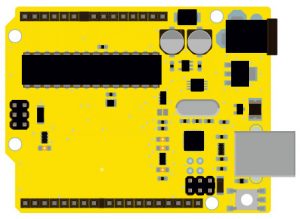
They come from a firm called What Next.
Yellow and Red boards are based on a Microchip ATmega328 microcontroller. Each provides 20 digital IOs – including up to six PWM outputs and six analogue inputs – plus a UART (with shared USB), TWI, and SPI.
To this, Red boards add an Esperiff ESP8266 Wi-Fi module for designing IoT projects – the self-contained ESP8266 SoC includes a TCP/IP protocol stack for connecting to a Wi-Fi network or acting as an access point.
Red board also support over-the-air programming, enabling wireless download of sketches and Wi-Fi firmware.
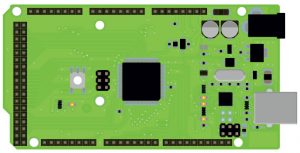 Intended for for larger products like 3D printers and robotics, Green board has more processing power and more functions, being built around an ATmega2560 microcontroller with 256kbyte of flash. The board offers 54 IO pins – including up to 12 PWM and 16 analogue inputs, as well as a 16MHz clock, four UART (one shared with USB), TWI, and SPI.
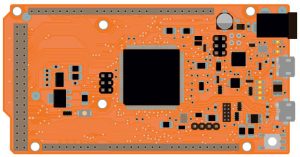 Orange is the most powerful board of the What’s Next line as its processor is a 32bit ARM Cortex-M3 clocked at 84MHz, within a SAM3X8E MCU with 512kbyte of flash. This board can operate from 3.3V and like Green has 54 digital IOs of which 12 can be PWM outputs, but this time only 12 of them can be analogue inputs. An addition is a pair of DACs, and more sophisticated serial comms including four UART (one shared with a USB OTG capable connection), two TWI, SPI, and a CAN bus – as well as a JTAG interface for direct programming and debugging.
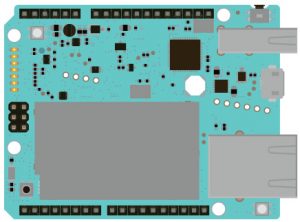 On top of these:
- Pink is a small board based on ATmega32U4
- Purple is a small board based ATmega328
- Turquoise is a fill-sized board based on ATmega32u4 MCU with a Qualcomm Atheros AR9331 for Ethernet ans Wi-Fi